Leadership Architecture Alignment Check
Key Takeaways:
- Leadership capability is built through an interconnected system—not through a leadership model or development program alone.
- As strategy, work, technology, and stakeholder expectations change, leadership systems that were once aligned can begin reinforcing different priorities.
- The critical question is where greater alignment would most strengthen the leadership capability the future business requires
Leadership Architecture Alignment Check
Organizations do not build leadership capability through a model or development program alone. They build it through the combined signals embedded in what leaders are expected to do, how leadership is assessed and developed, where talent investments are concentrated, how performance and succession decisions are made, and what customers, investors, employees, and other stakeholders ultimately experience.
RBL's Leadership Brand Architecture starts outside-in: with where the business is going, the stakeholders it must serve, and the value leaders must help create. It connects that business case to leadership expectations and to the talent and organizational systems that build, reinforce, measure, and sustain those expectations.
Alignment matters because leadership systems do more than communicate priorities—they shape which leadership capabilities are selected for, developed, rewarded, advanced, and ultimately institutionalized across the organization. When those systems reinforce the same logic, expectations become clearer, investment becomes more focused, and talent decisions build on one another. When they do not, leaders receive mixed signals, resources are spread across competing priorities, succession and development can reinforce different definitions of success, and the organization can invest heavily in leadership without building the capability the business actually needs.
Why revisit alignment now?
Alignment is not static. Even a well-designed leadership architecture can drift out of alignment as the business changes. Strategy shifts. Customer expectations evolve. Technology and AI change the work. Leadership levels across the organization face different judgment and accountability demands. And the roles where superior leadership creates the greatest strategic value can change.
Those changes do not make enduring leadership fundamentals obsolete. They increase the need to revisit emphasis, differentiation, and application. The challenge is not only to build a coherent leadership architecture once. It is to keep that architecture aligned as the business changes.
Leadership Brand Architecture: six elements that should reinforce one another
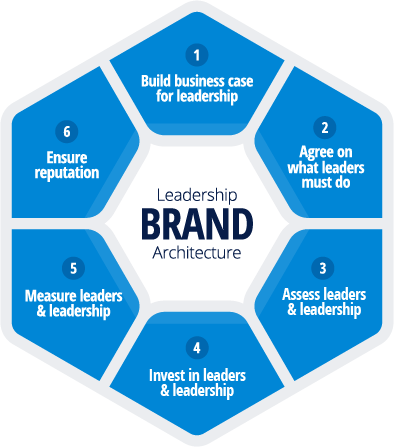
RBL uses six elements to organize the work of building leadership capability: build the business case, agree on what leaders must do, assess leaders and leadership, invest in leaders and leadership, measure leaders and leadership, and ensure reputation.
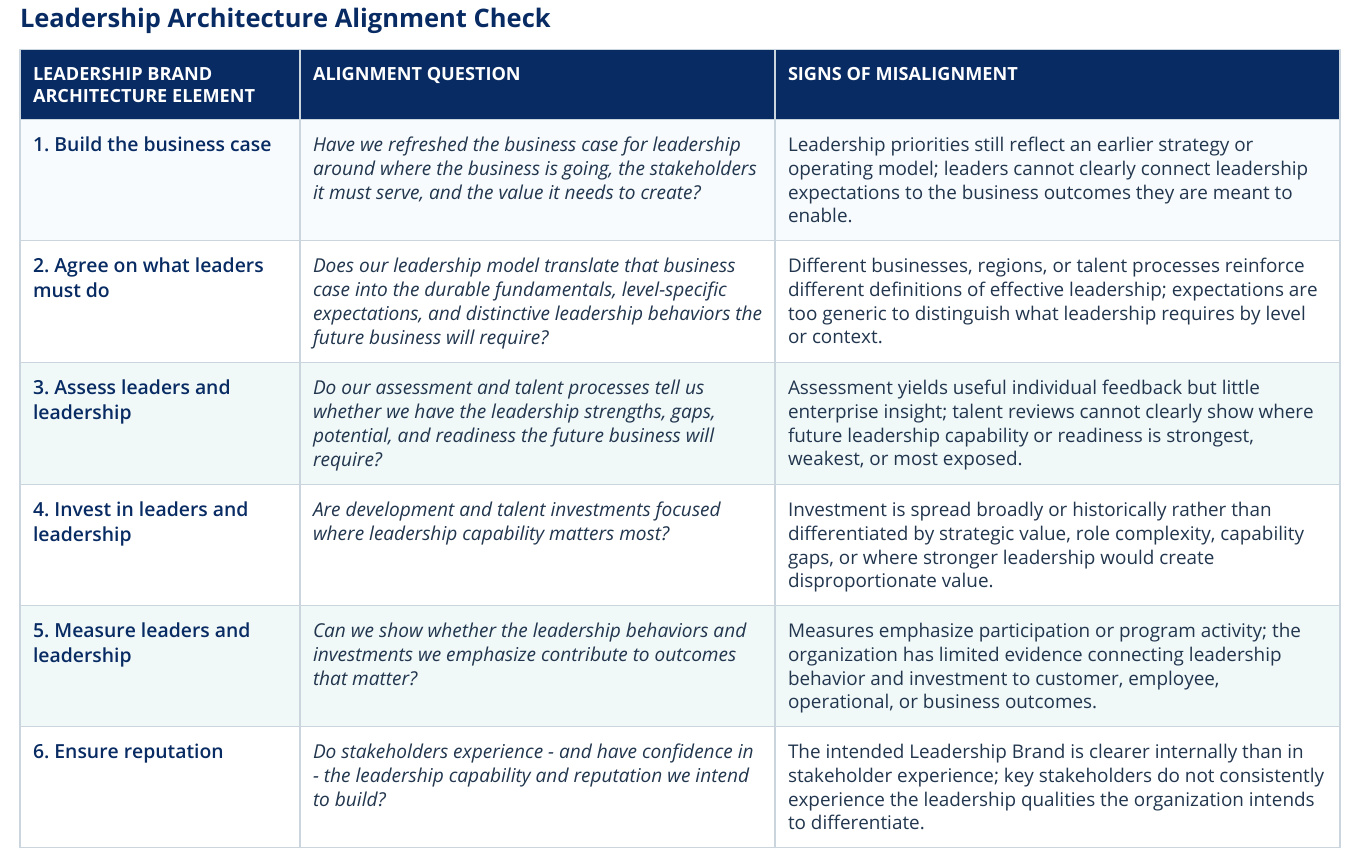
Six questions to test alignment
The more important question is not whether each element exists in your organization, but whether the six elements still reinforce the same future-facing business logic.
Viewed together, the six questions reveal whether the architecture is reinforcing one future-facing business logic—or whether its elements have begun to pull in different directions.
Why these gaps matter
Misalignment rarely appears as one obvious failure. More often, capable systems begin pulling in different directions. A leadership model may emphasize one set of priorities while succession decisions favor another. Assessment may identify strengths and gaps that development investments do not address. High-potential programs may build broad capability while strategically critical roles remain thinly staffed. Performance systems may reward outcomes or behaviors that conflict with stated leadership expectations. And leadership measures may demonstrate activity without showing whether the organization is actually building the capability its strategy requires.
The cost accumulates across the system. Leadership expectations become less clear. Talent decisions become less mutually reinforcing. Investment is dispersed. Bench strength may develop in the wrong places. And senior leaders have less confidence that substantial leadership investment is producing the capability required for future performance.
Alignment is therefore a continuing business question—not a one-time design exercise.

Interested in learning more about Leadership Transformation and Alignment?
Where is alignment breaking down?
Few organizations will answer all six questions with equal confidence—and that is useful.
The most important signals are often the places where the answer is unclear, where leaders hold different views, or where the organization is relying more on assumption than evidence. Those gaps can indicate that the leadership model, talent systems, investment priorities, and measures are no longer reinforcing the same business logic.
The practical question is not simply which element is weakest, but where misalignment is creating the greatest business consequence—for example, unclear leadership expectations, uneven development investment, weak bench strength in strategically important roles, inconsistent succession decisions, or limited evidence that leadership investments are producing the outcomes the business needs.
A useful next question: Where would greater alignment most strengthen the leadership capability your future business requires?
Explore where alignment matters most
If the Alignment Check surfaces uncertainty, conflicting assumptions, or areas where the system is no longer reinforcing the same business priorities, that is often where the most useful conversation begins.
RBL works with CHROs and senior talent leaders to build differentiated leadership capability and align the systems that reinforce it. In a 20-minute Leadership Architecture Alignment Discussion, we can examine where your current approach appears aligned, where misalignment may have the greatest business consequence, and whether further validation or deeper work would be useful.
No materials or preparation are required. Email Leslie Kawai at leslie.kawai@rbl.net or schedule a 20-minute conversation directly.
Related RBL thinking
Foundational reading: Dave Ulrich and Norm Smallwood, The Foundations of Effective Leadership, which outlines the outside-in logic of Leadership Brand Architecture and how organizations turn individual leader capability into organizational capability.