Strengthening Results Through Participative Cultures
KEY TAKEAWAYS:
- Participative cultures drive results: Organizations that create meaningful two-way dialogue build trust that strengthens over time and experience higher engagement, lower turnover, and improved financial performance.
- HR restructuring is often required to make participative culture-building possible: Strategic listening is facilitated by separating transactional HR work from strategic work, building data analytics capabilities, and aligning internal communications with HR to create genuine two-way channels.
- HR is uniquely positioned to connect the dots: HR sits at the intersection of employee experience, executive priorities, and quantitative insights and can surface issues and create solutions that truly address employee and business needs.
Strengthening Results Through Participative Cultures
A century of research shows that as communication becomes more two-way, transparent, and participative, organizational outcomes like engagement, trust, innovation, and financial performance measurably improve. More recently, RBL’s Leadership Code Research Initiative found that leaders who engage the organization to surface the right issues, find the best solutions, and create commitment and buy-in are better able to navigate the uncertainty of today’s world and deliver for customers, investors, and employees. While AI offers powerful capabilities for analyzing data and surfacing patterns, HR leaders who skillfully combine these insights with careful listening and strategic influencing are uniquely positioned to enact meaningful changes.
In participative cultures, the cycle of Data to Action (see Figure 1) is a repeating cycle, generating new insights that drive action. This cycle is strengthened through multiple revolutions. As employees see that their ideas are truly considered and acted upon and that their experience matters to leadership, the culture matures and employee trust in leadership grows. This increased trust leads to increased confidence in sharing feedback and ideas and greater participation in engagement surveys as well as more direct, non-anonymous sharing and problem solving. Ultimately, strong participative cultures lead to faster problem-solving and higher quality solutions, further strengthening an organization’s culture and employee engagement.
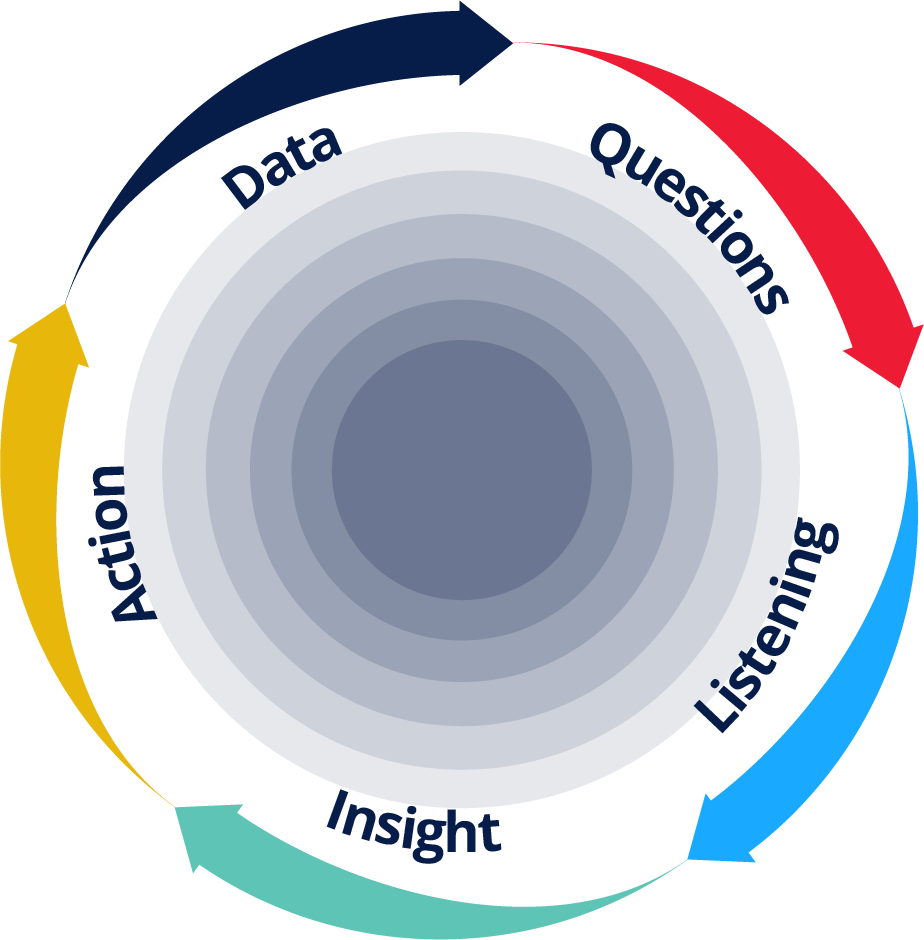
Figure 1. Data to Action Cycle
To further illustrate this cycle, consider two examples. One company chose to openly share data that highlighted lower-than-average employee engagement scores for female employees along with a commitment to do better. Transparently sharing this data inspired higher levels of trust, and several women accepted the opportunity to join focus groups or to share their ideas one-on-one with trusted members of the HR team. These sharing sessions surfaced several improvement opportunities, including that not all locations had women’s restrooms on-site. Adding women’s restrooms at all sites signaled a real commitment that built trust and other suggestions followed. In a more targeted example, a company identified the 100 employees it felt were the most important to develop and retain. Although employees were not told that they were part of this group, leaders across the company took an active interest in them – engaging with their development plans and understanding any possible issues that could lead to disengagement so that these could be addressed. As a result of these active and meaningful connections, turnover for these 100 employees was near 0 – ensuring that the leadership pipeline of the future would not be weakened by top employees choosing to leave.
HR Organizational Shifts that Support Participative Culture-Building
To really embed a participative culture across the whole organization often requires organizational changes in HR to carve out space for strategic listening and data analysis and create two-way information channels. In most HR organizations, the HR professionals closest to the business and to employees are often inundated with urgent essential HR tasks that make it challenging for them to find time to listen, connect the dots, and plan for action. Removing day-to-day essential work from strategic business partners and building data analytics capability apart from data collection and cleaning creates the space to surface questions and insights. Additionally, HR ownership or alignment of internal communications with HR creates a powerful lever for culture-building.
Some examples of how we have seen organizations shift HR structures to better support participative culture-building include:
- One company separated HR Business Partners and Employee Relations to enable the business partners to really get to know the businesses and their people. An additional benefit of this structure is that it creates multiple avenues for listening in cases where HRBPs are seen as strongly aligned with their business leaders and therefore a less safe place to share concerns or feedback.
- Another company created an HR data analytics function to provide HRBPs visibility to the needed data and enabled easy drilling down to root cause. All HRBPs were trained on the tools and then asked to use the tools to identify a root cause and create an action plan, reinforcing understanding of the tools and creating visible impact across the organization.
- One company stood up internal communications within the HR function to ensure employees understood where the business was focused and to regularly reinforce key aspects of the culture. As the role evolved, the internal communications strategy shifted to be more deliberately focused on supporting 2-way communication, including an interactive intranet as well as launch and oversight of Employee Resource Groups (ERGs). By balancing telling with listening, they were able to keep employees at the center and stay focused on employee-driven solutions.
HR leaders have long been called upon to “connect the dots” between the very human side of understanding employee needs and the harder skills of data analytics (engagement surveys, turnover data, etc.) to understand quantifiable opportunities that create stakeholder value. These organizational shifts facilitate listening, trust building, creativity, and pragmatic action that build a participative culture.
Lessons Learned
- Separating day-to-day essential HR work from strategic HR work: This creates the space for HR to facilitate a participative culture. By pulling essential work from strategic business partners, they have the time and space to think about the data, lead critical conversations, develop action plans, and make changes happen.
- Use both qualitative and quantitative data: Layering on the “hard” skills of data analytics helps to amplify employee voices – making the requests easier to understand by leaders who may not be as close to the issues and so may not understand the potential impacts. Sharing quantifiable gaps in engagement survey results for specific groups combined with qualitative stories gathered in more intimate feedback mechanisms can help create understanding and urgency around important employee experience issues. It can also help shift what might feel like a political conversation to being about taking care of people/team and making sure employees have the experience they need to contribute and drive results.
- Treat employees like adults: Truly understanding employees requires two-way dialogue, where employees at all levels are free to both listen to and share their ideas (surveys, focus groups, ERGs, etc.). Engaging employees openly and honestly requires significant courage – leaders must be ready to say “no” or “not now” to some impassioned ideas. A “no” combined with a reason still builds trust and a belief that management cares and is listening – reinforcing the cycle of data to action.
- Be focused and pragmatic: You can’t—and shouldn’t—act on everything. At the same time, it is important to ensure that one-off but important comments aren’t overlooked because they aren’t experienced by a large group of employees (safety concerns, hostile work environment, etc.). It can be easy to miss these micro-opportunities in big data but addressing these “broken window” moments creates trust and strengthens culture.

Why it Matters
The benefits to organizations who develop a participative culture are not just a feel-good story. In organizations we have worked with, this shift has resulted in concrete business results: improved customer satisfaction, higher employee:HR employee ratio, organization-wide decreases in SG&A as % of revenue, higher engagement scores, lower turnover, best workplace awards, and deeper applicant pools even in very tight labor markets. Skills traditionally thought of as “soft” (understanding, curiosity, empathy, EQ) can drive solid and measurable business value when used to build and sustain powerful cultures. This is especially true for HR leaders who sit at the intersection of understanding employees, understanding executives, and understanding the data.